Why Some Hamstring Injuries Refuse to Heal
You felt a sharp pull during a sprint, a deadlift, or maybe just reaching down to pick something up. The acute pain faded after a few weeks of rest — but a deep, achy soreness at the very top of your hamstring, right where it attaches to your sit bone, never quite went away. Sitting for long periods became uncomfortable. Stairs, hills, and any explosive movement trigger the same nagging pain every time.
This pattern is classic proximal hamstring tendinopathy (PHT) — and it's one of the most frustratingly stubborn injuries we treat at Pittsburgh Physical Medicine. The reason it lingers isn't weakness or tightness in the traditional sense. It's a structural problem in the tendon itself.
What's Actually Happening in the Tendon
A tendon's job is to transmit force from muscle to bone. It does this through tightly organized collagen fibers. When a tendon is overloaded — either by a sudden injury or repetitive stress — those fibers become disorganized. Blood vessels and nerve endings grow into the damaged area, which is normally a good thing in other tissues. In tendons, it causes a cycle of pain and failed healing.
The tendon becomes thickened, stiff in the wrong way, and hypersensitive to load. Rest alone doesn't fix this because tendons have poor blood supply to begin with. You can rest for months and the structural disorganization remains. The moment you reload the tendon, pain returns.
Key point: Tendinopathy is a failure of the tendon's normal repair process — not simply inflammation. Treatments that target inflammation (ice, anti-inflammatories) have limited effect on established tendinopathy.
Where Shockwave Therapy Comes In
Extracorporeal shockwave therapy (ESWT) delivers focused acoustic pressure waves directly into the tendon tissue. These waves do several things that rest and stretching cannot:
- Break up calcifications — calcium deposits that sometimes form in chronic tendinopathy are mechanically disrupted
- Stimulate collagen remodeling — the pressure waves signal the tendon to restart its repair cycle, promoting more organized collagen formation
- Temporarily reduce nerve sensitivity — overactive pain signals in the tendon are quieted, which allows the tissue to tolerate loading again
- Improve local blood flow — neovascularization (growth of new blood vessels) supports the healing environment
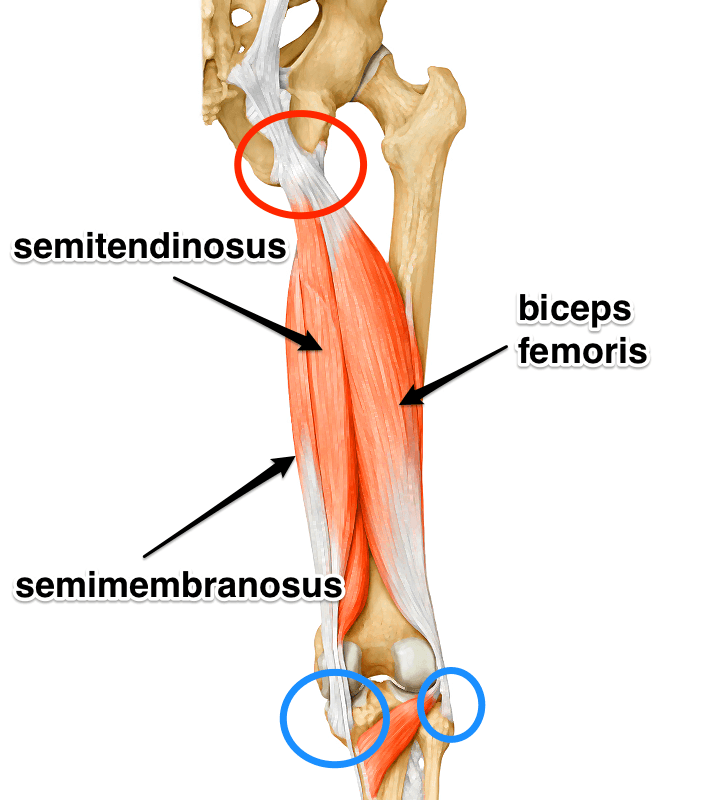
At Pittsburgh Physical Medicine, we use a focused shockwave unit that allows our providers to target specific depths within the tendon — critical for proximal hamstring tendinopathy, where the attachment sits deep near the ischial tuberosity (sit bone).
A typical course is 3–6 sessions spaced one week apart. Most patients begin to notice a reduction in baseline pain after the second or third session, though full tendon remodeling continues for weeks after treatment ends.
Why Shockwave Alone Isn't Enough
Shockwave therapy restarts the repair process. Physical therapy guides it in the right direction. Without progressive loading, the tendon heals in a disorganized way and vulnerability to re-injury remains high.
Our physical therapists design a structured tendon loading program that typically progresses through these phases:
- Isometric loading — contracting the hamstring without movement reduces pain and maintains neural drive to the muscle while the tendon begins to heal
- Isotonic loading — slow, controlled eccentric and concentric exercises under progressively increasing load (Nordic hamstring curls, Romanian deadlifts)
- Energy storage loading — once the tendon tolerates heavy slow resistance, spring-like movements are introduced (bounding, sprinting mechanics)
- Return to sport — sport-specific movement patterns reintroduced at controlled intensities before full return to activity
This progression is not optional. Jumping straight to high-load activities is what causes most re-injuries. Our PTs monitor your tissue response at each stage and adjust as needed.
What to Expect at Our Clinic
Your first visit includes a thorough evaluation to rule out other causes of posterior hip pain (sciatic nerve involvement, hip pathology, referred pain from the lumbar spine) and confirm tendinopathy. We use orthopedic tests, functional movement assessment, and load testing to understand exactly where you are in the injury cycle.
From there, shockwave sessions are typically 10–15 minutes and are performed alongside your PT appointments. Most patients see meaningful improvement within 4–8 weeks. Athletes returning to competitive sport may take 3–4 months for full rehabilitation.
Is This the Right Treatment for You?
PHT responds well to the shockwave + PT combination when:
- Pain has persisted for more than 6 weeks despite rest
- Sitting on hard surfaces or going upstairs reliably reproduces your pain
- You've tried stretching without sustained improvement (aggressive hamstring stretching can actually worsen tendinopathy by compressing the tendon against the ischium)
- You want to avoid or have been told to avoid corticosteroid injections (which can weaken tendon tissue with repeated use)
The treatment is not appropriate during acute tears, in patients with blood-clotting disorders, or over active infections. Our providers will screen for contraindications at your initial visit.
Schedule a Evaluation in East Liberty
Pittsburgh Physical Medicine serves patients from across the Pittsburgh area — Shadyside, Lawrenceville, Highland Park, Point Breeze, Bloomfield, and beyond. We're located at 5916 Penn Avenue in East Liberty and offer both chiropractic and physical therapy under one roof, allowing us to coordinate your shockwave and loading program seamlessly.
If you're dealing with persistent hamstring or sit bone pain, call us at (412) 404-8337 or book online below.