Two Conditions That Often Arrive Together
It starts with heel pain in the morning — those first few steps out of bed that feel like stepping on a sharp stone. Or maybe it's tightness in the back of the ankle that gets worse after sitting, then gradually loosens as you walk. For many patients, both happen at the same time.
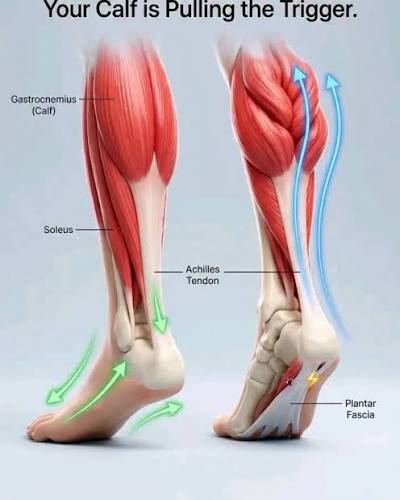
Plantar fasciitis and Achilles tendinopathy are anatomically distinct but functionally linked. The plantar fascia — the thick band of connective tissue running along the sole of your foot — and the Achilles tendon share a functional connection through the calf complex. Tightness, weakness, or altered mechanics in one almost always affects the other.
At Pittsburgh Physical Medicine, we frequently see patients who've been treating one condition in isolation, getting partial improvement, then wondering why the other keeps flaring. The answer lies in understanding how these structures work together.
The Anatomy of the Problem
Your calf is made up of two muscles — the gastrocnemius and the soleus — that merge into the Achilles tendon and attach to your heel bone (calcaneus). The plantar fascia attaches to that same heel bone on the bottom side and fans out toward your toes.
When your calf is tight or weak, it places excess tension on the Achilles tendon. That same tight calf also limits ankle dorsiflexion (your ability to pull your toes toward your shin), which increases the load placed on the plantar fascia with every step. The two structures can perpetuate each other's dysfunction in a cycle that stretching alone rarely breaks.
Clinical note: If you have chronic plantar fasciitis that keeps returning despite orthotics and stretching, assess your Achilles. If you have mid-portion Achilles tendinopathy, assess your plantar fascia load and calf strength. Treating in isolation is the most common reason patients don't get lasting relief.
How Shockwave Therapy Addresses Both
Extracorporeal shockwave therapy (ESWT) is one of the most evidence-supported treatments for both plantar fasciitis and Achilles tendinopathy. The acoustic pressure waves work through the same mechanisms in both tissues:
- Tendon/fascia remodeling — disorganized collagen fibers are stimulated to remodel into healthier, more organized tissue
- Calcification breakdown — calcium deposits that form in chronic cases (calcific Achilles tendinopathy, heel spurs associated with plantar fasciitis) are disrupted
- Pain reduction — overstimulated nociceptors (pain-signaling nerves) in the tissue are temporarily desensitized, allowing therapeutic loading to begin
- Neovascularization — new blood vessel formation supports the tissue repair environment
Because both the Achilles insertion and the plantar fascia attachment share the heel bone, we can often treat both areas in the same shockwave session. This simultaneous approach is more efficient and addresses the interconnected dysfunction rather than treating each structure in isolation.
Partial Tears: When to Be Careful
It's worth distinguishing between Achilles tendinopathy and partial Achilles tears — the treatment approach differs significantly.
Tendinopathy is degenerative change within the tendon without structural disruption. It responds well to progressive loading and shockwave. Partial tears involve actual structural damage to the tendon fibers and require a more conservative initial phase before loading is introduced.
Signs that you may have a partial tear rather than pure tendinopathy include sudden onset after a specific incident, a palpable gap or tender nodule in the tendon, significant swelling, and pain that is severe rather than aching. Diagnostic ultrasound can confirm the diagnosis. Our providers will assess this at your first visit.
The Physical Therapy Component
For both conditions, shockwave therapy is most effective when combined with structured physical therapy. The PT component typically includes:
For Achilles Tendinopathy
- Progressive calf loading — beginning with isometric holds, advancing to heavy slow resistance (heel drops on a step), then plyometric loading
- Hip and knee strengthening — weakness here forces the calf and Achilles to compensate
- Gait retraining — foot strike pattern and running mechanics are assessed and corrected if needed
For Plantar Fasciitis
- Intrinsic foot muscle strengthening — short-foot exercises, toe spreads, and arch activation drills
- Calf and Achilles flexibility (carefully graded — aggressive stretching too early can worsen symptoms)
- Load management — activity modification guidance to reduce cumulative daily stress on the fascia while healing
- Footwear and orthotic assessment when appropriate
What the Research Says
Multiple randomized controlled trials have compared shockwave therapy to placebo and corticosteroid injection for both conditions. The consistent finding: shockwave produces comparable short-term results to corticosteroid injection, with significantly better outcomes at 6 and 12 months. Corticosteroids can weaken connective tissue with repeated use — shockwave strengthens it.
When shockwave is combined with eccentric exercise programs, outcomes are consistently superior to either treatment alone. This is the approach we use at Pittsburgh Physical Medicine.
Timeline and What to Expect
Most patients with plantar fasciitis or Achilles tendinopathy respond within 4–8 weeks of combined shockwave and PT. Chronic cases (symptoms lasting more than 6 months) may take 10–12 weeks. A typical treatment course involves:
- 3–6 shockwave sessions (once weekly)
- Physical therapy visits 1–2 times per week during the active phase
- Home exercise program maintained throughout
- Gradual return to full activity as tissue tolerance improves
We also provide clear guidance on what you can and can't do during treatment. Unlike rest-based protocols, you don't need to stop all activity — you need to manage load intelligently while the tissue heals.
Book an Evaluation in Pittsburgh
Pittsburgh Physical Medicine is located at 5916 Penn Avenue in East Liberty, convenient to Shadyside, Lawrenceville, Highland Park, and the broader Pittsburgh area. We offer chiropractic care, physical therapy, and shockwave therapy under one roof — meaning your treatment plan can be coordinated efficiently without referrals between multiple practices.
Call (412) 404-8337 or book online to schedule your evaluation.